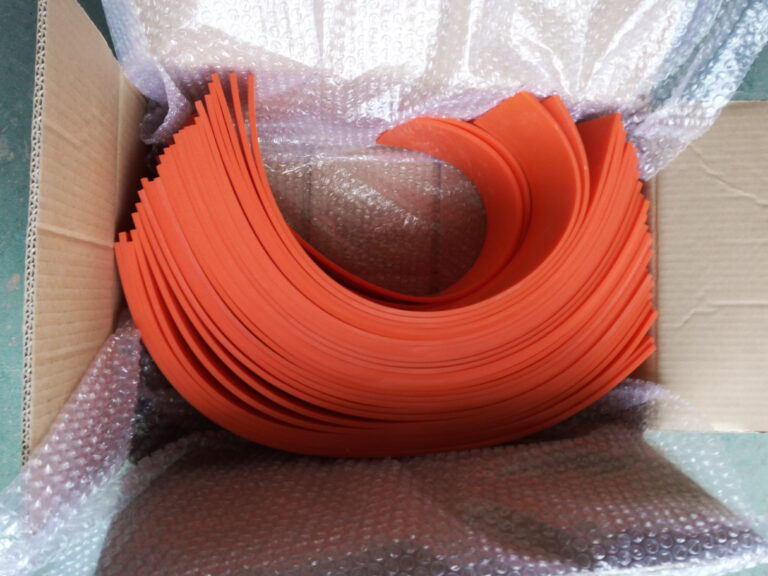
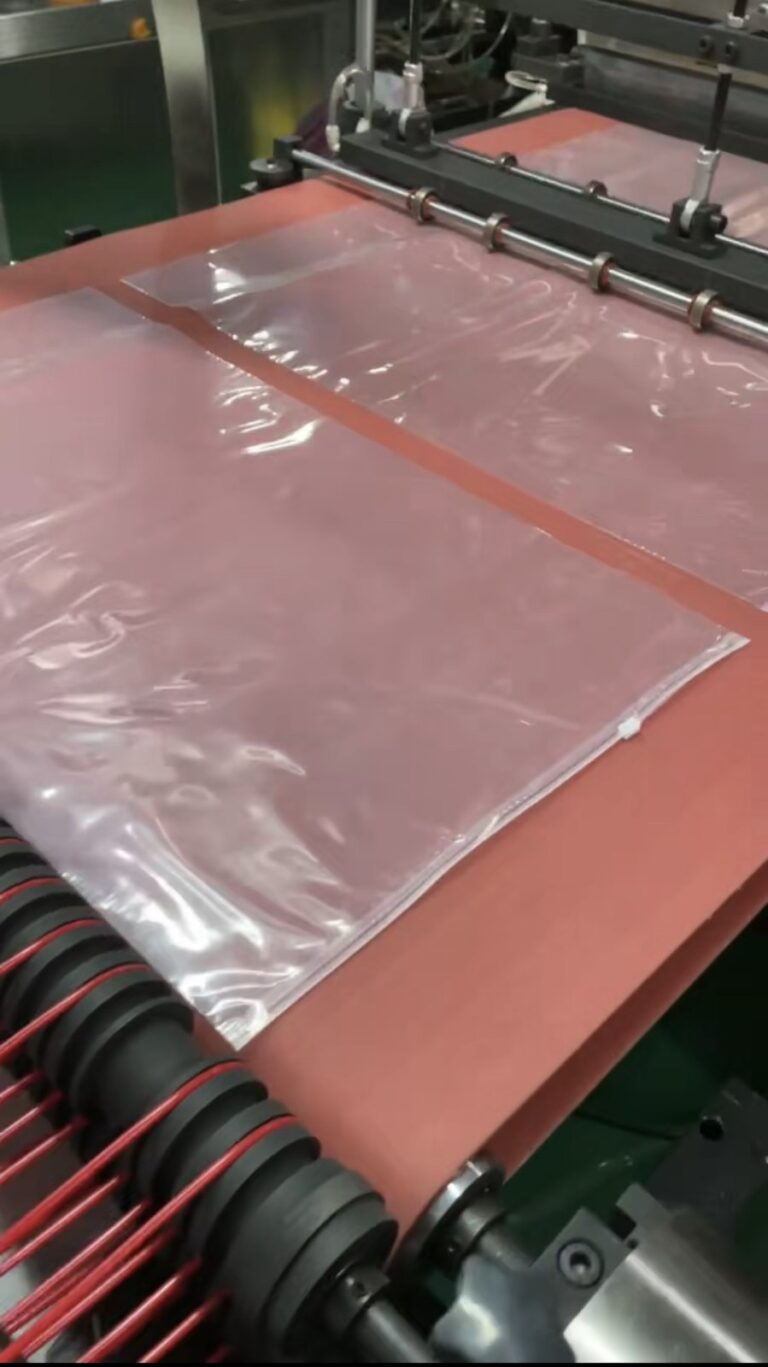
Silicone and PTFE conveyor belts are both used around heat, but they solve different problems. Silicone is an elastomer that can provide grip, cushioning and flexibility. A belt sold as a PTFE conveyor belt is commonly a woven glass or aramid fabric coated with PTFE, so its behavior depends on both the coating and the fabric construction.
The correct choice is based on the process, not the highest temperature printed in a brochure.
Performance comparison
| Design factor | Silicone belt | PTFE-coated fabric belt |
|---|---|---|
| Surface friction | Generally higher grip; useful for indexing, inclines and product control | Generally lower friction and better release |
| Conformity | Elastomeric and cushioning; can conform to product or nip variation | Thin and dimensionally stable, but less cushioning |
| Release | Good for many sticky products, but not always as low-friction as PTFE | Strong non-stick behavior for many heat-processing applications |
| Temperature decision | Depends strongly on compound, load, oxygen and cycle | Depends on PTFE grade, fabric, coating, seam and mechanical load |
| Joint | Vulcanized, molded or mechanically designed joint depending on construction | Overlap, finger, butt or mechanical seam can become the limiting area |
| Small pulleys | Thickness and reinforcement control bending stress | Fabric type, coating cracks and seam flexibility must be checked |
| Electrical behavior | Can provide insulation; corona applications require a complete electrical design | Insulating or static-dissipative constructions are available; verify exact grade |
Temperature ratings need context
Chemours states that some Teflon industrial coatings can operate continuously up to 260 °C. That coating value should not be copied directly to a finished conveyor belt. The base fabric, adhesive, edge treatment, seam, tension and exposure to flexing may have lower limits.
The same rule applies to silicone. A high-temperature sealant, molded compound and reinforced belt are different products. Ask for the continuous and intermittent limits of the complete belt construction under mechanical load.
Choose silicone when grip and compliance control the process
Silicone is often the better starting point when the product must accelerate without slipping, when a soft surface protects the product, when heat sealing requires controlled pressure, or when the belt works as an elastic contact layer. Reinforcement may be added when length stability and tracking are important.
Choose PTFE-coated fabric when release and low friction dominate
PTFE-coated belts are widely considered for drying, baking, laminating and heat-transfer processes where product release, chemical resistance or low surface friction is central. Check the seam location, coating damage at repeated bends and the effect of sharp product edges.
Do not assume food compliance
Food-contact suitability is not a generic property of a color or polymer family. Request documentation for the exact compound, coating, reinforcement, pigment, joint and manufacturing route. Also define the food type, temperature, contact time and cleaning process.
Run a side-by-side validation
- Define acceptance criteria: tracking, release force, product movement, marks, cleaning time and belt life.
- Use the same machine alignment, tension and process recipe for both constructions.
- Measure belt surface temperature rather than relying only on heater setpoint.
- Inspect the joint, edges and coating after a fixed number of thermal cycles.
- Record product quality and downtime, not only whether the belt still moves.
Illustrative decision example
This is an engineering example, not a claimed customer case. A sticky sheet releases poorly but must also stop at an exact position. A PTFE-coated belt may improve release but allow the sheet to slide during indexing. A silicone belt may improve position control but require a different surface finish for release. The correct test compares both product release force and stopping accuracy. A hybrid machine solution, such as controlled vacuum or a localized release surface, may outperform choosing either polymer by temperature alone.
RFQ checklist
- Product material, dimensions and surface condition
- Normal and peak temperature at the belt surface
- Required grip, release and allowable product marking
- Pulley diameters, speed, tension and support surface
- Chemicals, cleaning and regulatory documentation
- Joint, edge and tracking requirements
Discuss the process with GRFFN or review our silicone conveyor belt constructions.